
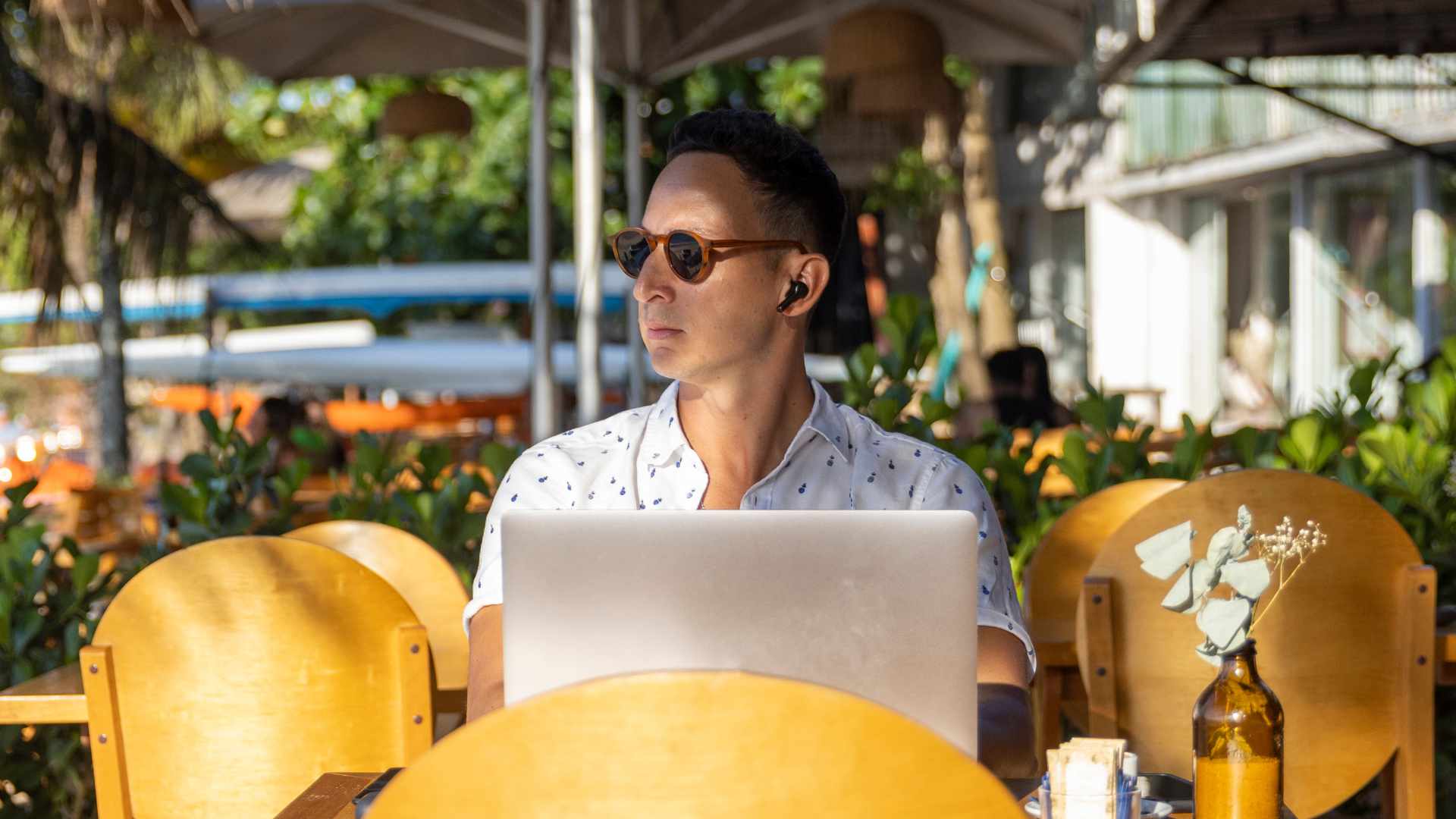
For years, the digital nomad was presented as a symbol of a new kind of professional freedom. A laptop, an internet connection, remote work, and the ability to choose the next point on the map.
This image is not fictional. For many people, it is reality. Digital technologies have indeed detached part of professional work from the physical office and made it possible to work across different countries, cities, and time zones.
But as research has expanded, it has become increasingly clear that digital nomadism is far more than working while traveling.
It affects how people organize their time, choose where to live, build social relationships, manage their professional lives, and decide whether a temporary destination could eventually become home.
The effects now extend well beyond individual choice. Cities are changing their infrastructure and the way they position themselves for mobile professionals. The coworking industry is expanding. Housing markets are responding to international demand. Governments are creating visa regimes and policies for people whose work is no longer tied to a specific location.
For this reason, digital nomadism can no longer easily be viewed as a peripheral lifestyle. It is part of a broader transformation in the relationship between work, mobility, and place.
Mobile work is changing the boundary between professional and personal life
One of the greatest advantages of remote work is autonomy. When employees are no longer required to be physically present in an office, they gain greater freedom over where they work, when they work, and how they organize their day.
That freedom, however, has another side.
The traditional office creates relatively clear physical and temporal boundaries. A person arrives at work, stays for a defined period, and then leaves. For digital nomads, those boundaries are often much less distinct.
The workplace may be an apartment in the morning, a coworking space in the afternoon, and a hotel room in the evening. Clients may be located across different time zones, while professional communication remains accessible almost continuously.
Rainoldi, Ladkin, and Buhalis analyzed 224 digital diary entries and conducted 32 in-depth interviews with digital nomads. They identified 25 practices through which participants managed the relationship between work and leisure. The authors distinguish several major types of boundaries (Rainoldi et al., 2025):
- spatial;
- material;
- temporal;
- social;
- psychological.
In mobile work, a significant share of these boundaries must be created and maintained by the individual.
The less external structure there is around the working day, the more responsibility for organization shifts to the individual professional. Freedom from the office requires a higher degree of self-discipline.
Digital nomads can choose where they work, but they must also decide for themselves when work ends.
Choosing a destination now also means evaluating working conditions
Mobile work changes the way a destination is evaluated.
For tourists, climate, food, architecture, nature, and cultural attractions may be decisive. For digital nomads, another set of practical conditions must be added.
- reliable internet connectivity;
- suitable accommodation;
- a quiet place for online meetings;
- access to coworking spaces;
- good transportation connectivity;
- a workable time zone relative to clients or employers;
- services that support a normal daily routine.
Cook and Hannonen examine this change in Chiang Mai and describe it through the concept of the digital nomad gaze. According to them, digital nomads perceive destinations through a combination of cultural, tourism-related, and professional characteristics. The ability to work productively becomes part of how the place itself is evaluated (Cook & Hannonen, 2026).
This creates an interesting paradox.
Many digital nomads seek deeper contact with local culture and do not want to be perceived as ordinary tourists. At the same time, their professional commitments can limit precisely that kind of engagement.
A person may spend several months in Thailand while their working day remains connected primarily to clients and colleagues in Europe or North America.
Physically, they are present in one place. Professionally, they remain connected to another.
This is one reason Cohen and Hannonen place digital nomadism within the broader framework of lifestyle mobilities, in which traditional boundaries between tourism, work, migration, and everyday life gradually become less distinct (Cohen & Hannonen, 2026).
Coworking spaces are becoming part of the urban ecosystem
This transformation is particularly visible in coworking spaces.
Initially, their role was relatively straightforward: to provide a desk, internet access, and a professional environment for people without a permanent office. Today, many coworking spaces offer a much broader proposition that includes:
- professional and social events;
- access to local business networks;
- communities of remote workers and entrepreneurs;
- social activities;
- services that support adaptation to the city.
Sanchez-Vergara and Orel describe this process in Barcelona as the touristification of work. Coworking spaces are increasingly adopting elements from the hospitality industry and combining work infrastructure with social environments and urban experiences (Sanchez-Vergara & Orel, 2026).
This also changes the business model itself.
The coworking operator is no longer selling only a place to work. It provides an environment in which mobile professionals can orient themselves more quickly, build contacts, and develop a sense of belonging.
This function is particularly valuable because constant mobility makes it more difficult to build durable social relationships.
In this way, the coworking space gradually becomes an intermediary between professional activity, social life, and the city.
Extended mobility increases the need for stability
The next question is what happens when this way of life continues for years.
Henkens studied 27 digital nomads in Bali from a life-course perspective. Participants viewed many aspects of nomadism positively, but many of them did not see high mobility as a permanent model for their entire lives. In the future, they expected greater residential stability, either by settling in one place or by rotating between several familiar bases (Henkens, 2025).
Mobility creates a sense of freedom, but every relocation requires a new layer of organization:
- finding accommodation;
- dealing with administrative requirements;
- building a new social environment;
- creating new daily routes and routines;
- finding an appropriate work environment;
- adapting to local rules and services.
Over time, movement begins to consume the very resource that initially seemed to have been freed through mobility.
This also changes the way people think about place.
The initial question is:
“Where do I want to go?”
Later, it may become:
“Where do I want to return?”
And eventually:
“Where can I build a sustainable life?”
The digital settler changes the logic of mobility
This is where one of the most interesting concepts in recent research appears.
Koufodontis and Gaki use the term digital settler to describe people who continue to work independently of location but build a more lasting relationship with a particular region (Koufodontis & Gaki, 2025).
They may continue to travel, but they now have a stable base. They build local relationships, use local services on a continuing basis, and participate more deeply in the local economy and everyday life.
As the duration of stay increases, the criteria for choosing a place also change.
For a short stay, low costs, good internet access, and a pleasant climate may be decisive. When the perspective shifts toward a longer-term life, other factors come to the forefront:
- quality of healthcare;
- local safety;
- quality of municipal services;
- institutional stability;
- predictability of the everyday environment.
Koufodontis and Gaki identify precisely these differences in their study of Greece (2025).
This has direct implications for regional policy.
Attracting a mobile professional and retaining that person are two different tasks.
For the first, marketing, strong internet infrastructure, and a convenient visa process can help. For the second, the place itself needs to function well as a society.
International mobility does not mean the same level of professional freedom for everyone
The popular image of the digital nomad implies a high degree of autonomy. The reality is considerably more diverse.
Riesgo Gomez and colleagues examine transnational digital workers in Lisbon who are employed through intermediary companies in areas such as content moderation, customer service, and technical support for global platforms.
These workers participate in the digital economy and are internationally mobile, but their professional environment may be characterized by control, repetition, emotional strain, and instability (Riesgo Gomez et al., 2025).
The authors use the term transnational digital worker, which helps distinguish between different forms of international mobility.
- One person relocates because their work allows them to choose where they live.
- Another relocates because a specific job is available in a particular place.
Both participate in the global digital economy, but their degree of autonomy is different.
For this reason, the term “digital nomad” can conceal substantial differences in income, social protection, professional independence, and actual freedom of choice.
Geoarbitrage is an economic strategy, but deciding where to live is more complex
Another frequently used concept is geoarbitrage.
In its simplest form, it describes a situation in which a person earns income from a wealthier economy while living in a lower-cost country. This increases their purchasing power.
Sciuva, however, shows that this explanation is too limited. In his study of digital nomads in Lisbon, geoarbitrage is treated as a broader strategy involving economic, social, professional, and temporal differences between places (Sciuva, 2026).
The decision may be influenced by:
- cost of living;
- professional opportunities;
- the social environment;
- quality of life;
- professional networks;
- the stage of the life course;
- the period during which this type of mobility remains practically possible.
This explains why digital nomads are difficult to describe exclusively as privileged individuals or as insecure workers.
The same person may have greater purchasing power than local residents while simultaneously lacking a stable employment contract or a secure retirement outlook.
Geographic freedom and professional insecurity can exist at the same time.
Mobile work is also beginning to influence housing markets
Individual decisions gradually create collective consequences.
Malaga is a revealing example.
Díaz-Parra, España, and Jover examine the relationship between remote work, international mobility, and the housing market. According to the data used in the study, rents in the city increased by approximately 60 percent between 2020 and 2024 (Díaz-Parra et al., 2026).
The authors do not claim that digital nomads are the only cause. Housing pressure is created by the interaction of several processes:
- tourism demand;
- remote work;
- international professional mobility;
- real estate platforms;
- the expansion of the mid-term rental market.
This distinction is important.
Digital nomads can easily become a convenient explanation for a housing problem that actually has multiple causes.
But the relationship between mobile work and local housing markets can no longer be ignored.
When income from wealthier economies enters a housing market shaped around lower local incomes, prices can gradually move beyond the purchasing power of local residents.
This creates tension between individual freedom of movement and the sustainability of the local environment.
Cities are beginning to compete for mobile human capital
This change also has strategic significance.
Cities have traditionally competed for investment, companies, tourists, and skilled employees. Now another group is being added: people who can take their work with them.
Xiao and Lutz studied 571 participants from China and the United States and found that expectations regarding the institutional and policy environment are strongly associated with the intention to become a digital nomad. Visa regimes, administrative clarity, infrastructure, and the perceived practical feasibility of this way of life play an important role in that decision (Xiao & Lutz, 2026).
For this reason, a strategy for attracting mobile professionals cannot be limited to promoting climate, beaches, and coworking spaces. It depends on:
- the quality of public administration;
- the accessibility and quality of housing;
- digital and transportation infrastructure;
- safety;
- clarity of tax and visa rules;
- the quality of everyday public and private services;
- the relationship between mobile professionals and the local community.
This leads to a more important strategic question.
Not how many digital nomads a city can attract.
But how many it makes sense to retain, for how long, and under what conditions.
The next phase is choosing where to stay
Technology has already largely answered the question of whether we can work outside the office.
The more difficult question is what kind of life we build around that freedom.
Research points to several consistent trends:
- continuous mobility has practical and psychological limits;
- working without a fixed office requires a higher degree of personal discipline;
- extended mobility makes stable social relationships more difficult to maintain;
- cities can benefit from mobile human capital, but they can also face pressure on housing and infrastructure;
- as stays become longer, people begin to value institutional stability and quality of everyday life more than the short-term attractiveness of a destination.
For this reason, the future of digital nomadism will probably not be defined by the number of countries visited in a single year.
More important will be the ability to combine mobility with stability, professional autonomy with social belonging, and global income with local participation.
Digital transformation has given many professionals the ability to choose where they want to be.
The next phase will be about something more fundamental:
how we choose where to stay.
References
Cohen, S., & Hannonen, O. (2026). A review of research into lifestyle mobilities and digital nomadism. Annals of Tourism Research, 116, 104067. https://doi.org/10.1016/j.annals.2025.104067
Cook, D., & Hannonen, O. (2026). The digital nomad gaze: Ethnographic insights from Chiang Mai. Annals of Tourism Research, 116, 104066. https://doi.org/10.1016/j.annals.2025.104066
Díaz-Parra, I., España, E., & Jover, J. (2026). When it rains, it pours. Digital nomads, platform real estate, and the housing crisis in Malaga. Digital Geography and Society, 10, 100156. https://doi.org/10.1016/j.diggeo.2026.100156
Henkens, J. H. D. (2025). Digital nomadism from a life course perspective. Advances in Life Course Research, 64, 100673. https://doi.org/10.1016/j.alcr.2025.100673
Koufodontis, N. I., & Gaki, E. (2025). Digital nomads or digital settlers? Rethinking regional development in the information age. Geoforum, 167, 104466. https://doi.org/10.1016/j.geoforum.2025.104466
Rainoldi, M., Ladkin, A., & Buhalis, D. (2025). Digital nomads’ work-leisure management practices. Annals of Tourism Research, 111, 103904. https://doi.org/10.1016/j.annals.2025.103904
Riesgo Gomez, V., Cortez, P., Gil, J., & Sequera, J. (2025). Beyond the digital nomad: Transnational digital workers in Lisbon. Digital Geography and Society, 9, 100148. https://doi.org/10.1016/j.diggeo.2025.100148
Sanchez-Vergara, J. I., & Orel, M. (2026). The touristification of work: Coworking spaces and digital nomads in Barcelona. City, Culture and Society, 44, 100687. https://doi.org/10.1016/j.ccs.2025.100687
Sciuva, E. (2026). (Geo)arbitraged lives: Unpacking the spatio-temporal strategies of digital nomadism. Geoforum, 173, 104661. https://doi.org/10.1016/j.geoforum.2026.104661
Xiao, Y., & Lutz, C. (2026). Drivers and barriers of digital nomadism: A cross-country comparison of Chinese and US samples. Journal of Destination Marketing & Management, 42, 101151. https://doi.org/10.1016/j.jdmm.2026.101151
Was this insight valuable to your business?
Download our free app TemplinTech Magazine on Google Play – no ads, no distractions, just focused business insights.
📲 Install from Google Play










Comments (0)
No comments yet.